




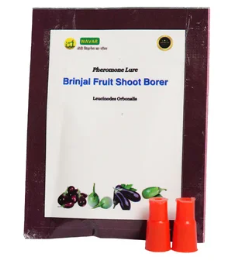
Brinjal shoot borer lure (Only Lure)
Regular price
₹100
Regular price
MRP
₹150
Sale price
₹100
Unit price
per
Inclusive of all Taxes.
Couldn't load pickup availability
Short Description
Brinjal Fruit Shoot Borer Lure
Leucinodes Orbonalis
Leucinodes Orbonalis
Country of origin: India
Specifications
- Weight (Approx.) : 0.15 kg
- Lure Type : Brinjal Fruit Shoot Borer (Leucinodes Orbonalis)
- Shelf Life : 45-60 days
- Recommended to be Used with : Solar Light Trap, Water Trap, and Delta Trap
- Dosage : 10-12 Lure/acre
Description
Introducing Brinjal Fruit Shoot Borer Lure (Leucinodes Orbonalis). The Brinjal Fruit Shoot Borer Lure contains two high-quality pheromone lures designed to attract and trap the destructive Leucinodes orbonalis moths, a major pest of brinjal crops. Each lure releases a potent blend of E-11-hexadecenyl acetate and E-11-hexadecenol that effectively attracts male moths for early pest detection and mass trapping. With an active life of 30-45 days, these lures aid in reducing pest incidence and crop damage, improving yield quality. Suitable for use with funnel, water, or sleeve traps, the lure supports Integrated Pest Management (IPM) and sustainable farming. Easy to deploy, it is recommended to place traps at canopy level, with 8-10 traps per acre for monitoring and 40-50 traps per hectare for mass trapping.
Features
:- Lure Brinjal Fruit Shoot Borer (Leucinodes Orbonalis), Pesticide-Free Protection.
- Lure Brinjal Fruit Shoot Borer (Leucinodes Orbonalis) are invasive pests that can cause 90% to 100% loss of yield. Mostly used in Brinjal Crops
- Descriptions-Host Crop-Brinjal
- Insect- Fruit and Shoot Borer
- Dosage-10-12 lure/acre uniformly distributed across the field. Recommended to be used with solar light traps,water traps and delta traps
Applications
:- Monitoring and mass trapping Brinjal Fruit and Shoot Borer in brinjal (eggplant) farms
- Use in funnel, water, or sleeve traps placed just above crop canopy
- Suitable for open fields and protected cultivation (greenhouses)
- Supports sustainable farming by reducing pesticide use
- Helps early detection and pest population management
- Recommended for Integrated Pest Management (IPM) programs
 English
 हिन्दी
 मराठी
मराठी